

Rehabilitation
Are you unsure that you are inadmissible to Canada as a result of a past criminal offence or conviction?
- You may not be – not every overseas conviction has a Canadian equivalent!
- If it does, a Certificate of Rehabilitation or Deemed Rehabilitation could apply to your case.
At Bellissimo Immigration Law Group PC, we can help you make sense of it all and find solutions!
To provide an overview, the assessment starts with where you were convicted (in Canada or another country), how serious the conviction was, and if there is a Canadian equivalence. While accurately assessing admissibility to Canada is a challenging task, be sure that a qualified expert can help you assess it.
What makes someone inadmissible?
Section 36 of the Immigration and Refugee Protection Act sets out when a permanent resident and/or a foreign national may be found to be inadmissible to Canada as a result of past criminal convictions, which would involve “criminality” or “serious criminality”:
36 (1) A permanent resident or a foreign national is inadmissible on grounds of serious criminality for
(a) having been convicted in Canada of an offence under an Act of Parliament punishable by a maximum term of imprisonment of at least 10 years, or of an offence under an Act of Parliament for which a term of imprisonment of more than six months has been imposed;
(b) having been convicted of an offence outside Canada that, if committed in Canada, would constitute an offence under an Act of Parliament punishable by a maximum term of imprisonment of at least 10 years; or
(c) committing an act outside Canada that is an offence in the place where it was committed and that, if committed in Canada, would constitute an offence under an Act of Parliament punishable by a maximum term of imprisonment of at least 10 years.
36 (2) A foreign national is inadmissible on grounds of criminality for
(a) having been convicted in Canada of an offence under an Act of Parliament punishable by way of indictment, or of two offences under any Act of Parliament not arising out of a single occurrence;
(b) having been convicted outside Canada of an offence that, if committed in Canada, would constitute an indictable offence under an Act of Parliament, or of two offences not arising out of a single occurrence that, if committed in Canada, would constitute offences under an Act of Parliament;
(c) committing an act outside Canada that is an offence in the place where it was committed and that, if committed in Canada, would constitute an indictable offence under an Act of Parliament; or
(d) committing, on entering Canada, an offence under an Act of Parliament prescribed by regulations.
As indicated, what matters the most is how your offence and conviction will be treated in Canada. There are two ways the Court can convict an individual in Canada – by Summary or Indictment. A Summary conviction is less serious while a conviction on Indictment carries more serious consequences. It is similar to USA’s legal system, which has misdemeanors (less serious) and felonies (more serious).
Assessing the type of conviction is an important consideration because even if your conviction was equivalent to a Summary offence (Canada), if it could possibly be prosecuted by Summary or an Indictment (referred to as a “Hybrid” offence), Immigration, Refugees and Citizenship Canada (IRCC) will consider it an Indictment absolutely, which could mean the difference between “criminality” or “serious criminality”, and that makes a significant difference when considering relief applications.
Outside the basics, there are many other factors to consider, such as:
- How old you were when you were convicted
- How the Court dealt with the matter. If you received a “Stay”, a “Discharge”, “Peace bond”, “Deferral”, or even an “Expungement” (this may not be considered a conviction in Canada for the purposes of immigration).
- If you received a Pardon, there may be a way to advocate on your behalf.
As well, if you have only been charged, and not yet been convicted – it is key to learn the collateral immigration consequences before accepting any plea – be sure to speak to a qualified immigration lawyer.
If already convicted of a criminal offence or found to have “committed such an act”, and determined to be inadmissible to Canada, a Certificate of Rehabilitation, deemed or individual is an option if enough time has passed.
Eligibility for Rehabilitation and/or Deemed Rehabilitation
Section 17 and 18 of the Immigration and Refugee Protection Regulations sets out the prescribed periods for rehabilitation. For ease of review, a summary of eligibility requirements for rehabilitation and deemed rehabilitation based on various types of offences and convictions is provided below current to the time of posting. Please consult with Bellissimo Immigration Law Group PC or another authorized representative to determine if these provisions remain current and/or are applicable to your case.
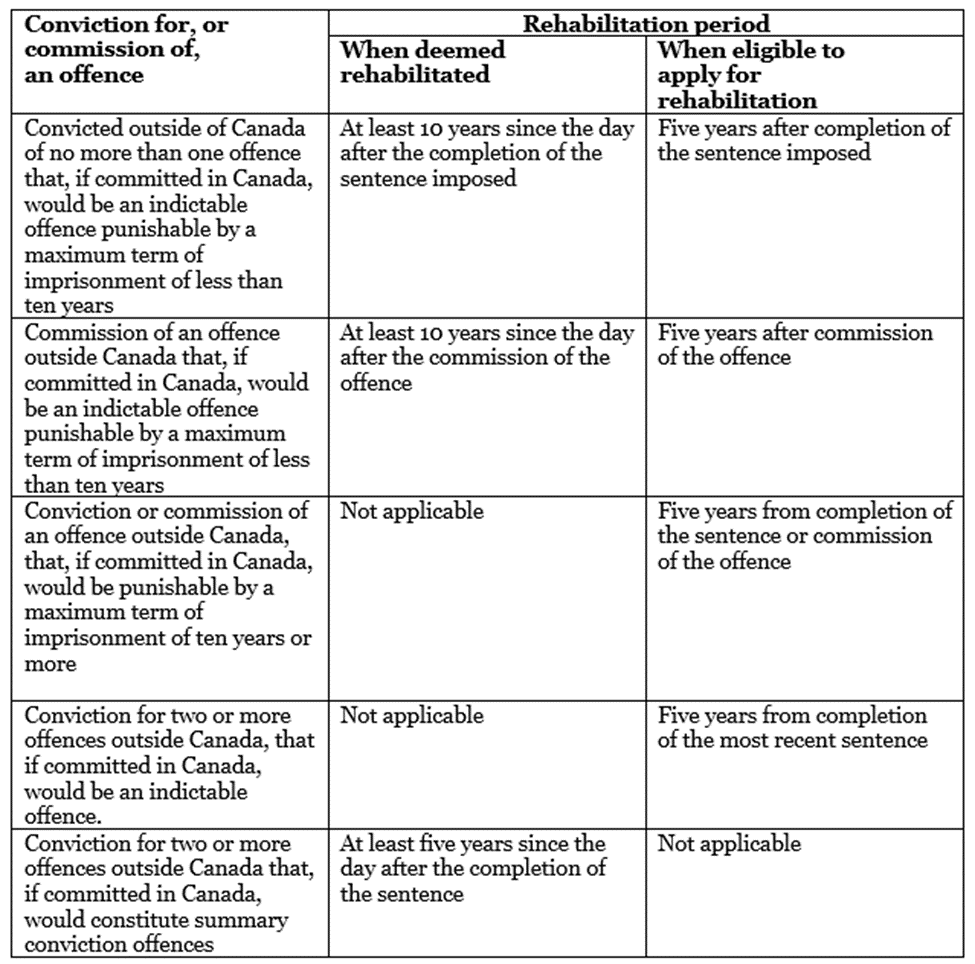
Please note that the eligibility date differs depending on the type of sentence imposed. The below list provides general guidance when assessing the eligibility date for the five-or ten-year waiting period:
- With respect to a suspended sentence, count five or ten years from the date of sentencing;
- With respect to a suspended sentence accompanied by a fine, count five years from the date the fine was paid, or the date of the last payment;
- With respect to imprisonment without parole, the eligibility date is five or ten years from the end of the term of imprisonment;
- With respect to a sentence of imprisonment with parole, count five or ten years from the completion and discharge from parole;
- With respect to probation only, the eligibility date will be five or ten years from the end of the probation period; and,
- With respect to a driving prohibition, count five or ten years from the end date of the prohibition. This last point is arguable when it comes to its applicability. To learn more, contact Bellissimo Immigration Law Group PC.
Application Process seeking Rehabilitation and/or Deemed Rehabilitation
If eligible, a person may submit a formal application for rehabilitation. A $200 processing fee is required for those who are inadmissible for criminality only. For individuals who are inadmissible for serious criminality, the processing fee is $1,000. In comparison, when applying to be deemed rehabilitated, there is no processing fee, no formal application package, and no discretionary decision – although mandatory supporting documents are still required to establish eligibility, and a legal submission is still recommended. Deemed Rehabilitation is not an option for those who are inadmissible for serious criminality.
The legal test IRCC utilizes to determine if an individual has been Rehabilitated includes whether the individual leads a stable life versus that of a criminal type of lifestyle, is a risk for re-offending, and has been effectively reformed and rehabilitated
A number of considerations that assist in the officer’s assessment, including:
- Whether the individual has a minimal offence history;
- Social and vocational skills;
- Counseling or therapy to attain rehabilitation;
- Establishment in the community;
- Whether the individual displays a fair degree of comfort with a criminal lifestyle;
- Whether the individual displays a pattern of long-term involvement with criminal activities;
- Whether the crimes are motivated towards material gain;
- Whether the individual has had numerous changes in residence and inability to provide consistent financial support;
- Whether the individual has instability in employment, family life, and living situation; etc.
Further, those with the following convictions or exhibiting the following behavioural traits may require an interview and a thorough assessment of their background:
- Pattern of offences that suggests a criminal lifestyle;
- Use of weapons or explosives;
- Violence or hostage-taking;
- Sexual assault;
- Substance or alcohol abuse;
- Use of force;
- Trafficking of narcotics; and,
- Fraud.
Review of applications for Rehabilitation often involves a two-stage review and the ultimate decision-maker is not obliged to accept the recommendation of the immigration officer who first reviewed the application. The final decision will be communicated in writing. Where a negative decision has been rendered, there may be merit to challenge the refusal to the Federal Court of Canada.
Contact Bellissimo Immigration Law Group PC today for further information on how we can assist with your Rehabilitation or Deemed Rehabilitation application.
Important Immigration Court Decisions


